
Home › Trading Training › Volume Trading Analysis
Volume Trading Analysis: The Expert Guide 2026
Breakouts | Divergences | Smart Money | Indicators
Introduction • Volume Types • Breakouts • Differences • Indicators • FAQ
Why is Volume Essential in Trading?
Le volume trading analysis is one of the most powerful yet most underestimated tools for traders. While the majority focus solely on price, professionals know that volume reveals the Hidden truth of the market : the actual conviction of the participants.
By 2026, mastering volume analysis will allow you to validate your breakouts, detect reversals, and track institutional investor flows. Discover in this comprehensive guide how to never trade blindly again, thanks to the tools available on TradingView.
What you will learn
- Understanding volume and its different forms
- Validate your breakouts thanks to the volume
- Detect reversals with the differences
- Use the Volume Profile like the pros
- Identify institutional areas
What is Volume in Trading?
Le volume Volume represents the total number of units of an asset traded over a given period. It is the oldest and most reliable indicator for measuring actual market activity. In effective volume analysis, this tool reveals what price alone cannot: the conviction of market participants.
In practical terms, volume measures the intensity of buyer and seller engagement. A price movement accompanied by high volume indicates strong conviction, while a movement with low volume suggests a lack of participation and therefore lower reliability.
Why is volume so important?
The famous trader Richard Wyckoff claimed that ""Volume is the fuel that drives the market."". This metaphor perfectly illustrates the role of volume:
- Confirmation of movements: A breakout without volume is suspicious. Volume either validates or invalidates price signals.
- Reversal detection: Discrepancies between price and volume often signal changes in trends.
- Identification of "Smart Money": Volume spikes reveal the activity of institutional investors and "power players".
- Liquidity measurement: High volume ensures better execution of your orders with less slippage.
The Different Types of Volume
Actual Volume (Exchange)
Official volume reported by the exchanges. For stocks, futures and ETFs, this is the exact number of contracts traded.
Tick Volume
Used in Forex trading. Measures the number of price changes, not the actual volume. Remains a reliable indicator of market activity.
Volume Profile
Displays the trading volume at each price level. Reveals areas of interest for institutional investors.
Volume and Validation of Breakouts
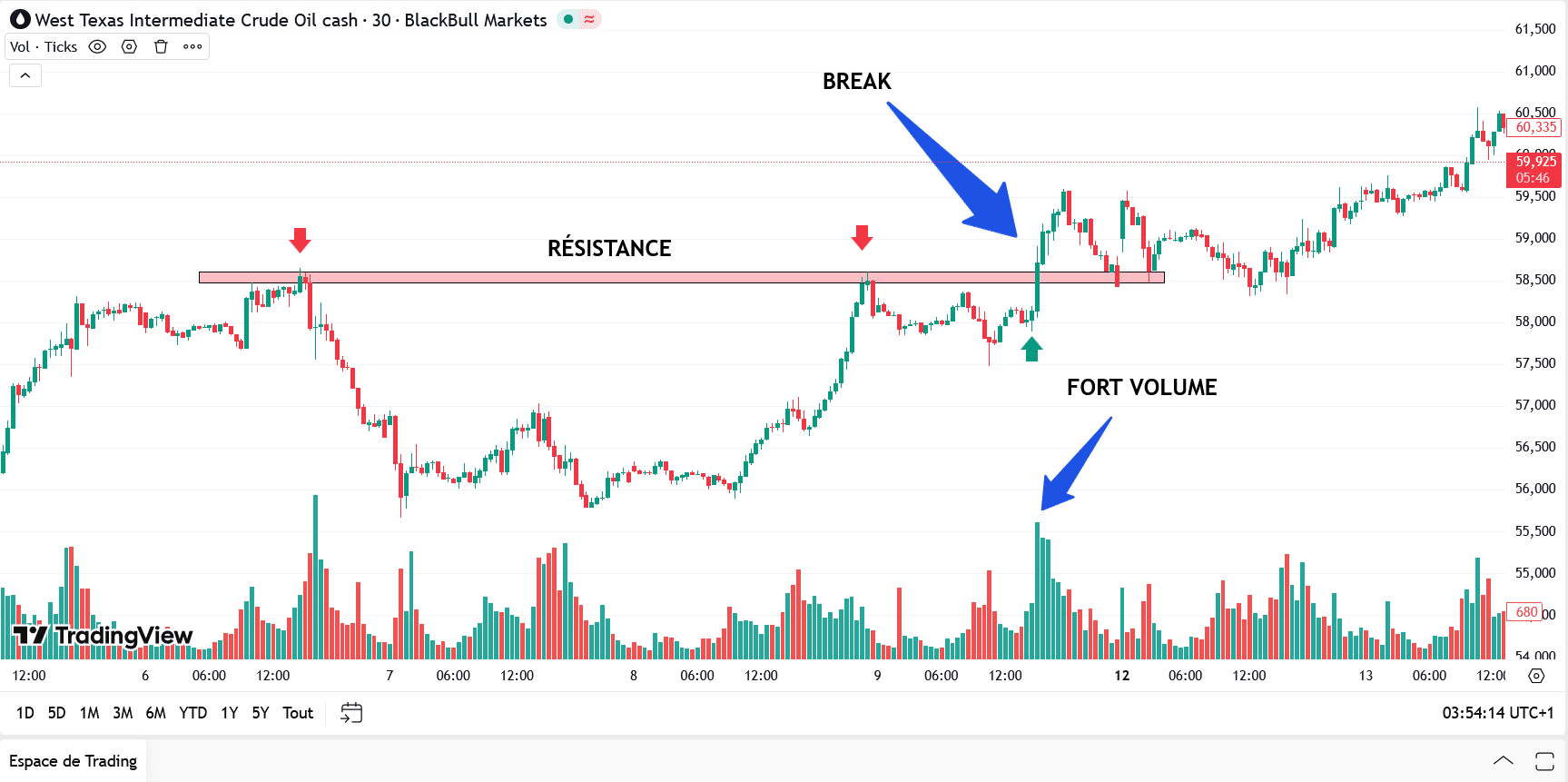
One of the most powerful applications of volume is the validation of breakouts. A breakout at a key level must be accompanied by a significant increase in volume to be considered valid.
The Golden Rule of Breakout
Breakout + High Volume = Reliable Signal
Breakout + Low Volume = Likely False Signal
How to interpret the volume on a breakout?
- Volume twice the average: Very reliable breakout, strong conviction
- Volume 1.5x the average: Acceptable breakout, monitor for confirmation
- Volume below average: Breakout suspected, risk of a trap (bull/bear trap)
On TradingView, Use the "Volume" indicator with a 20-period moving average to easily identify significant volume spikes.
Price/Volume Discrepancies: Anticipating Turnarounds

The discrepancies between price and volume These are among the most powerful signals for anticipating trend reversals. They occur when price and volume move in opposite directions.
Bearish Divergence
Signal: The price is making higher and higher highs, but the volume is gradually decreasing.
Interpretation: Buyers are losing steam. The upward trend is losing momentum. A bearish reversal is likely.
Bullish Divergence
Signal: The price is making lower and lower lows, but the volume is decreasing.
Interpretation: Sellers are exhausted. Selling pressure is easing. A bullish reversal is imminent.
Key Volume Indicators
OBV (On-Balance Volume)
Accumulates volume based on price direction. Excellent for confirming trends and detecting divergences.
VWAP
Volume-weighted average price. Used by institutional investors as a benchmark. Dynamic support/resistance.
Volume Delta
Difference between buyer and seller volume. Reveals the dominant pressure in real time.
FAQ - Volume Trading Analysis
Conclusion
Mastering the volume trading analysis It allows you to validate your breakouts, anticipate reversals thanks to divergences, and identify areas where institutional investors intervene massively.
Remember: A price movement without volume is suspicious, a movement with volume is confirmed.
Always incorporate volume analysis into your trading routine. Before each trade, ask yourself the following question: ""Does the volume confirm this trend?"" This simple habit will filter out many bad trades and significantly improve your success rate.