
Home › Trading News › Shutdown USA 2025
US Shutdown 2025: A Review of the Longest in History
43 days of paralysis | Market impact | Risk January 2026

The Capitol in Washington during the US shutdown 2025
Of October 1st to November 13th, 2025, The United States experienced the longest government shutdown in its history: 43 days of government closure. More than a million federal employees without pay, economic data never released, and a Fed blinded by a lack of statistics.
For traders, this shutdown has created an unprecedented situation: It is impossible to know the unemployment rate for October 2025., because the data was never collected. The dollar initially acted as a safe-haven currency, before falling after the agreement was announced.
Bad news: The agreement reached is only temporary. The funding expires. end of January 2026. A new shutdown could hit as early as February if no final agreement is reached.
Summary
What is a US shutdown?
A shutdown (or "government shutdown") occurs when the U.S. Congress fails to pass the federal budget by the deadline. Without approved funding, the federal government must cease all activities deemed "non-essential.".
Specifically, during a shutdown:
- "Non-essential" federal employees are being furloughed without pay.
- National parks, museums and monuments are closing their doors
- Statistical agencies cease collecting and publishing economic data
- Essential services (military, security, air traffic control) continue but without payroll
- Social assistance (food vouchers) may be suspended.
Le US shutdown 2025 has become the longest in American history, surpassing the record of 35 days set in 2018-2019 under the first Trump administration.
Key Figures for the 2025 US Government Shutdown
Did you know?
- The unemployment rate for October 2025 has NEVER been published because the data was not collected.
- This is the first time in modern history that the Fed has been navigating blindly for so long.
- Food stamps have been suspended in several states (New York, Texas, Pennsylvania)
- According to S&P Global, the economic impact was -0.1% to -0.2% of GDP per week
Complete Timeline of the US Shutdown 2025
| Date | Event | Impact |
|---|---|---|
| October 1, 2025 | The shutdown begins at midnight. | Closure of non-essential services |
| November 5, 2025 | Day 36 - Historic record broken | Exceeds the 2018-2019 shutdown |
| November 9, 2025 | Provisional agreement in the Senate | Markets anticipate the end |
| November 10-11, 2025 | Senate vote 60-40 | Market rebound (+1.4% Nasdaq) |
| November 12, 2025 | House of Representatives Vote | Final validation |
| November 13, 2025 | Trump's signature (10:25 PM) | Official end - 43 days |
US Shutdown 2025: Why Traders Are Concerned
For most people, a shutdown is a political curiosity. For traders, the US shutdown 2025 was a major visibility problem. Here's why:
Data missing
- Unemployment rate October 2025: never published
- Delayed inflation data
- Employment statistics not collected
- Economic reports suspended
Trading consequences
- Fed in the dark about its decisions
- Markets without fundamental benchmarks
- Increased volatility in the forex market
- Disrupted macro strategies
Key point for traders
Jerome Powell himself acknowledged it: the Fed had to make its November decisions without the usual data. This uncertainty partly explains his caution regarding a rate cut in December. Traders who follow the economic calendar have had to adapt their strategies in the face of this statistical "black hole.".
US Shutdown 2025: Impact on Financial Markets
Paradoxically, the stock markets held up relatively well during the US shutdown 2025. This is a historical phenomenon: shutdowns generally have little direct impact on the indices.
Market reaction on November 10 (announcement of the agreement)
- CAC 40: +1.37%
- Dow Jones: +0.37%
- S&P 500: +0.9%
- Nasdaq: +1.42%
- Nvidia: +5.8%
- VIX (fear index): -22%
Historically, Government shutdowns do not have a major impact on stock markets. During the 1995-96 shutdown (21 days), the S&P 500 was up. During the 2013 shutdown (16 days), it gained 31%.
The real volatility is found on the foreign exchange (forex) market, particularly on the dollar.
Shutdown USA 2025: Analysis of the Dollar (DXY)
The Dollar Index (DXY) exhibited revealing behavior during the 43 days of the US shutdown 2025 :
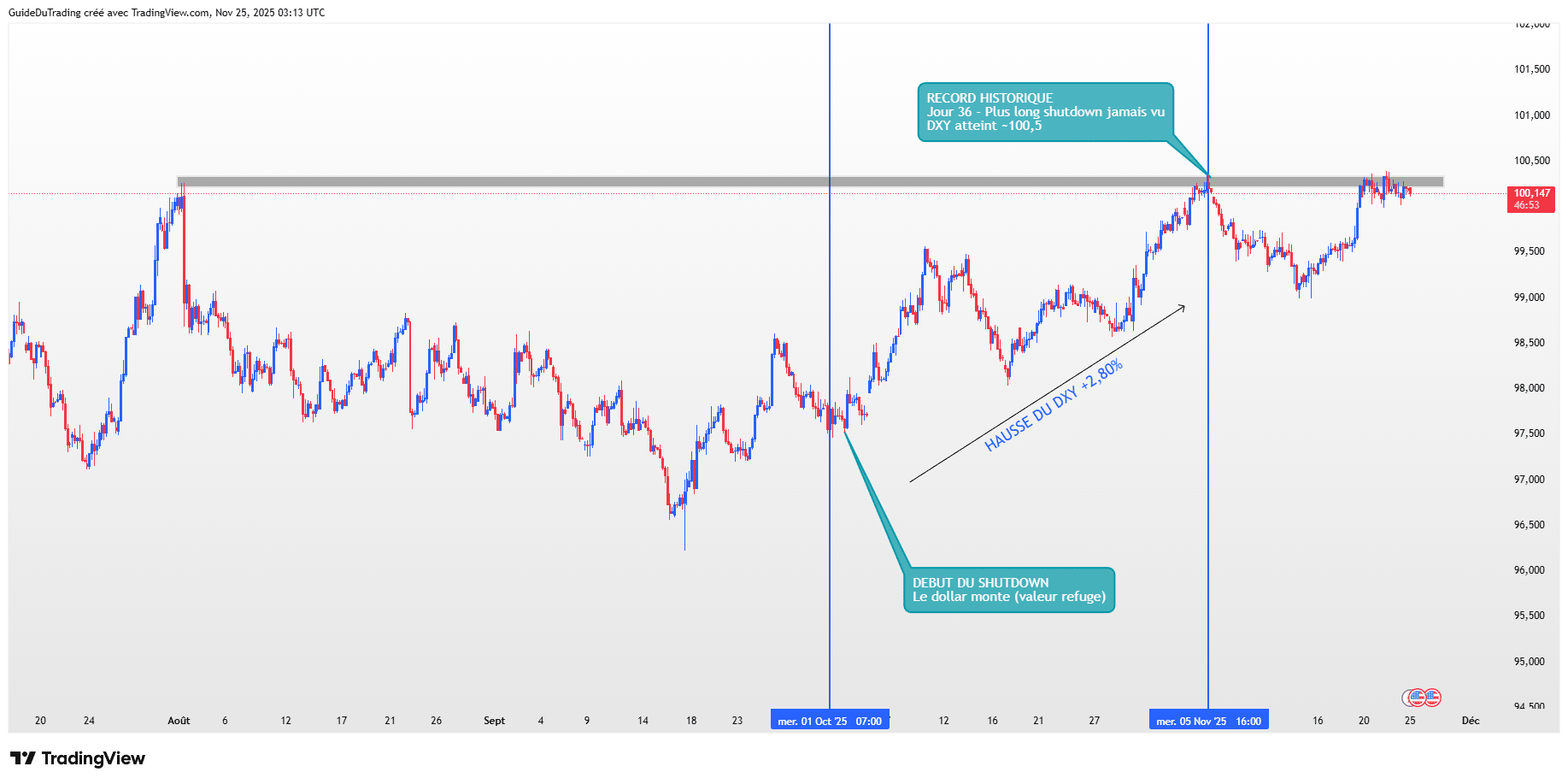
DXY Chart: Dollar Rise During US Shutdown 2025 (October 1 - November 5)
Technical analysis of the DXY during the shutdown
- October 1st → November 5th: Dollar rise (98.5 → 100.5) - Safe haven
- November 5th → November 13th: Gradual decrease - Anticipation of the agreement
- After November 13th: Dollar rebounds - Return to normal, end of uncertainty
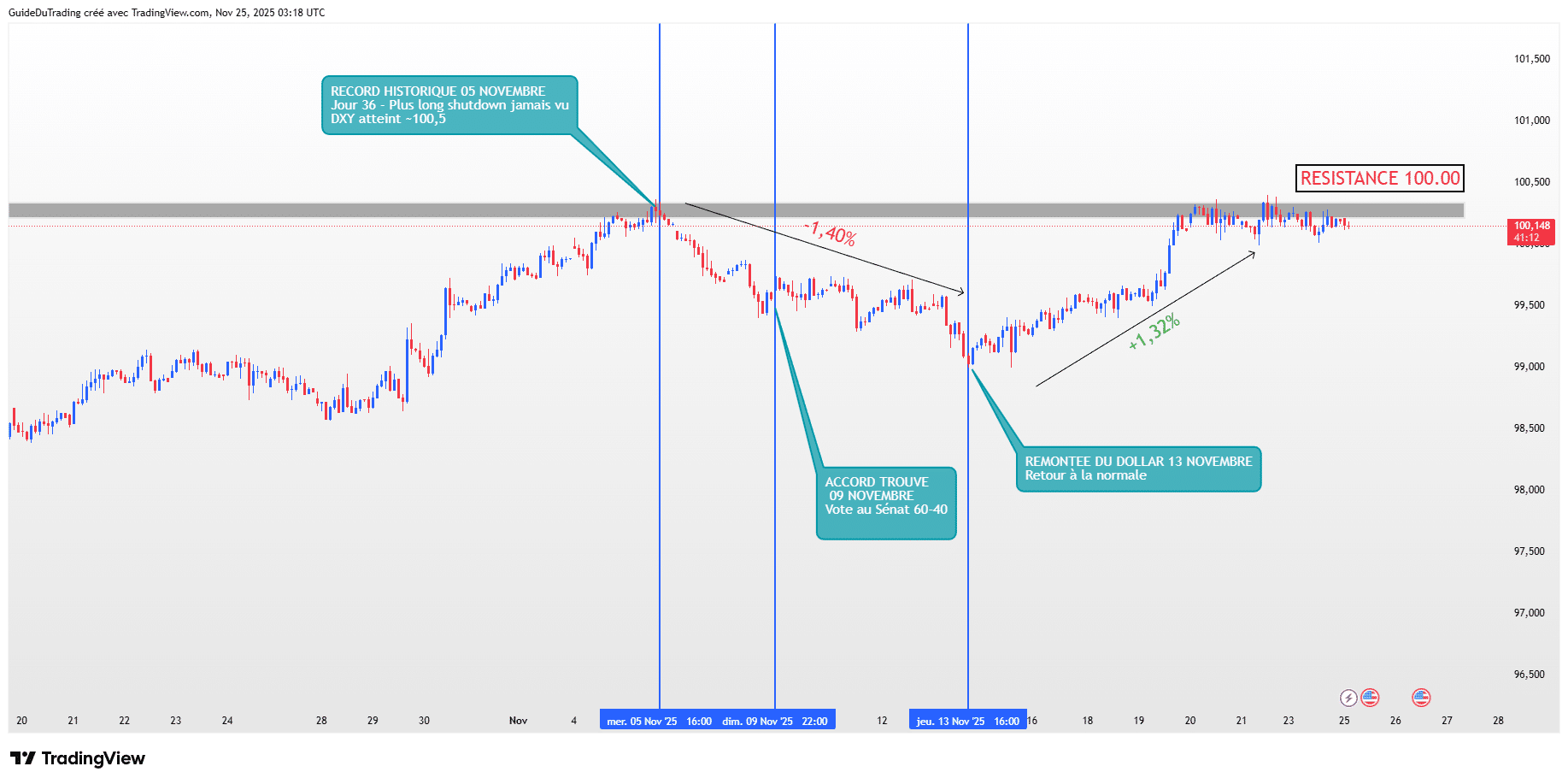
DXY Chart: Decline in anticipation of the agreement (November 5-13) then recovery after the end of the US shutdown 2025
Explanation : In times of political uncertainty, the US dollar traditionally plays its role as safe haven. Investors buy dollars to protect themselves. Once the crisis is resolved, the movement temporarily reverses before returning to normal.
Warning: New Shutdown Possible in January 2026
The US 2025 shutdown is not over!
The agreement signed on November 13, 2025 is only a temporary funding. The budget expires. end of January 2026. If no final agreement is reached by then, a new shutdown could begin as soon as possible. February 2026.
The same sticking points persist in Congress:
Points of friction for January 2026
- Budget cuts: Republicans want to cut spending, Democrats resist
- Obamacare (ACA): The Republican party wants to eliminate health subsidies
- Migration policy: Funding for the wall and border controls
- Federal debt: Debt ceiling to be renegotiated
Calendar to watch
Mid-December 2025: Vote on ACA health subsidies
End of January 2026: Temporary funding expires
February 2026: Risk of another shutdown if no agreement is reached
How to Trade in the Face of the USA Shutdown 2025
Here are the best practices for navigating a shutdown as a trader:
5 Tips for Trading During a Shutdown
- Reduce your exposure: The lack of data creates uncertainty; reduce the size of your positions.
- Monitor the DXY: The dollar is the asset most sensitive to government shutdowns.
- Trade political announcements: Every rumor of an agreement creates volatility
- Avoid macro strategies: Without economic data, fundamentals are blind.
- Prepare for the rebound: The end of the shutdown always creates a net movement in the markets
Key takeaways
- The 2025 shutdown lasted 43 days (a historical record).
- The economic data for October 2025 is permanently lost.
- The dollar plays its role as a safe haven during times of uncertainty.
- Stock markets generally withstand shutdowns well.
- A new shutdown is possible as early as February 2026
- Keep an eye on the political calendar to anticipate upcoming developments.
FAQ Shutdown USA 2025
How long did the US shutdown last in 2025?
The 2025 shutdown lasted 43 days, from October 1 to November 13, 2025. This is the longest shutdown in US history, surpassing the record of 35 days set in 2018-2019.
Why did the US 2025 shutdown happen?
The US Congress failed to pass the federal budget before October 1, 2025. The disagreements mainly concerned the budget cuts requested by the Republicans and the Health subsidies (ACA/Obamacare) defended by the Democrats.
What impact will this have on the markets?
The stock markets held up relatively well (rebounding from +0.9% to +1.4% following the announcement of the agreement). dollar (DXY) It initially rose (as a safe haven), then fell as the agreement approached. VIX fell by 22% on the day of the announcement.
Will there be another shutdown in 2026?
It's possible. The agreement of November 13, 2025 is only temporary funding until end of January 2026. If no final agreement is reached, a new shutdown could begin as early as February 2026.
How to trade during a shutdown?
Reduce your exposure, monitor the dollar (DXY), avoid macro-based strategies, and prepare to trade the rebound at the end of the shutdown. Volatility in forex is generally higher than in stocks.
Related Articles
Warning : CFD trading carries a high level of risk and may not be suitable for all investors. Leverage can amplify potential losses. 74-89% retail accounts lose money. Only invest what you can afford to lose.