
Home › Trading Guides › Fair Value Gap FVG
Fair Value Gap FVG: Complete Guide 2026
Advanced Liquidity Strategy - Master the Inefficiencies of Smart Money
Definition | Key Figures | Technical Structure | BISI vs SIBI | Strategies | Confluences | Errors | Timeframes | FAQ
Fair Value Gap FVG This is the concept of trading that has revolutionized the approach to financial markets in recent years. Fair Value Gap, FVG, often abbreviated as FVG, refers to a price imbalance directly visible on the chart, created by an impulse so rapid that orders were executed in only one direction. Understanding and exploiting these zones of inefficiency means learning to read the traces left by institutional algorithms and the Smart Money.
What is a Fair Value Gap (FVG)?
A Fair Value Gap (FVG) forms when a price impulse is so rapid and aggressive that orders are executed in only one direction – buy or sell. This creates a liquid void visible on the chart as a space between the upper wick of candle 1 and the lower wick of candle 3, in a sequence of three consecutive candles.
This concept is at the heart of the approach Smart Money Concepts (SMC) and the method ICT (Inner Circle Trader). The market tends to return to fill these areas of inefficiency to regain its equilibrium.
Simplified Definition
A Fair Value Gap = an empty space between 3 candles where the price has not been exchanged in a balanced way. The market will naturally seek to return to this zone to fill it, partially or completely.
Key FVG Trading Figures
Filling Rate
The majority of Fair Value Gaps are partially or totally filled by price.
Optimal Entry Zone
The FVG (Consequent Encroachment) retracement at 50% offers the best risk/reward ratio.
Recommended Timeframes
FVGs on higher time units have the highest reaction rate.
Technical Structure of the Fair Value Gap
To spot a Fair Value Gap On a graph, you need to analyze a sequence of three consecutive candles. Here is the exact breakdown of the structure:
Candle 1: The Primer
This is the last candle before the impulse. Its upper wick (bullish FVG) or lower wick (bearish FVG) defines the gap limit.
Candle 2: The Impulse
This is the imbalance candle. Its wide body and directional movement create the gap. It is the heart of the LVF.
Candle 3: The Confirmation
Its lower wick (bullish FVG) or its upper wick (bearish FVG) defines the other limit of the gap. The space between B1 and B3 constitutes the FVG.
Structure of a Fair Value Gap: the space between the wick of candle 1 and the wick of candle 3.
BISI vs SIBI: The Two Types of Fair Value Gap
Not all FVGs are the same. Depending on the direction of movement, two main categories are used in the context of the Smart Money Concepts :
| Characteristic | BISI (Buyside Imbalance) | SIBI (Sellside Imbalance) |
|---|---|---|
| Direction | FVG bullish | FVG bearish |
| Movement | Upward impulse | Downward impulse |
| Gap zone | Below the current price (support) | Above the current price (resistance) |
| Use | Purchase area during return | Sales area upon return |
| Consequent Encroachment | 50% of the FVG = optimal entry point | 50% of the FVG = optimal entry point |
| Invalidation | Fence under the FVG | Fence above the FVG |
Important Tip
A BISI An unfilled gap in a bull market is a sign of extreme strength. Conversely, a SIBI An unfilled position in a bear market confirms selling pressure. Do not force an entry if the left-hand side (LWS) is not in the direction of the prevailing trend.
How to Trade the Fair Value Gap (FVG)
Here are the three most effective strategies for exploiting a Fair Value Gap in your trading operations:
Strategy 1: 50% retracement
Wait for the price to retest the middle of the FVG (Consequent Encroachment). Place your limit order at this precise level for optimal entry with a tight stop-loss.
Strategy 2: FVG + Order Block
The confluence of a Fair Value Gap and an Order Block is a high-probability signal. When these two zones overlap, the price reaction is generally strong.
Strategy 3: FVG + Liquidity Sweep
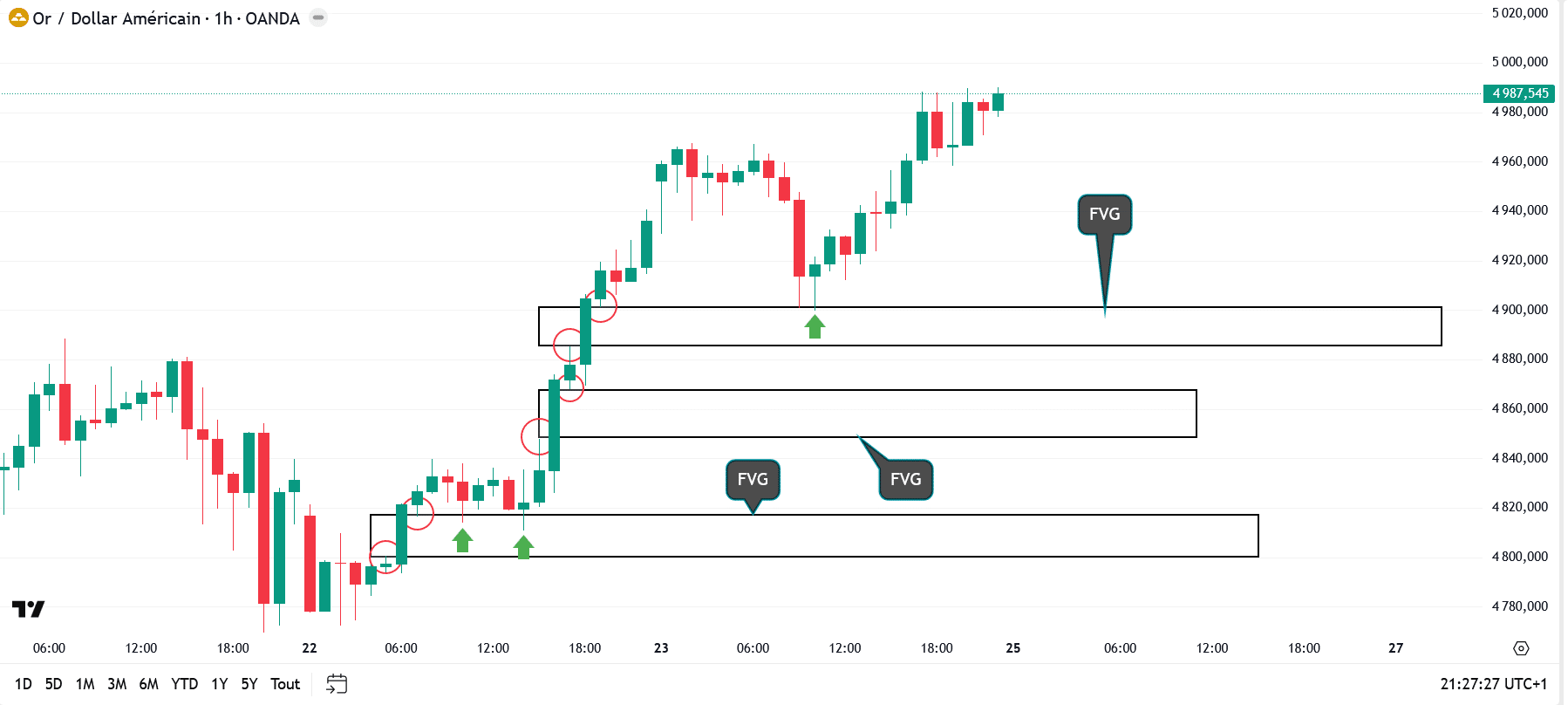
Wait for a liquidity sweep (stop-loss trigger) followed by a return to the FVG. This is the quintessential institutional setup used by Smart Money.

Real-world application: entry on FVG with confluence Order Block and Liquidity Sweep.
Risk Management Rules
- + Stop-loss: Place it behind the impulse candle (candle 2) of the FVG, never in the middle of the gap.
- + Take-profit: target the next liquidity level (previous high/low, opposite Order Block).
- + Risk per trade: Never exceed 1 to 2% of your capital per position.
- + Risk/return ratio: aim for a minimum of 1:2, ideally 1:3 or more.
- + Confirmation: Wait for a price reaction in the FVG (rejection candle, engulfing) before entering.
Confluences: Combining FVG with other SMC Tools
A Fair Value Gap Being alone is not enough to place a trade. Professional traders look for confluences between several elements of Smart Money Concepts to maximize the probability of success.
| Confluence | Description | Reliability |
|---|---|---|
| FVG + Order Block | The FVG overlaps an institutional order block | Very high |
| FVG + Liquidity Sweep | Liquidite flush before returning to the FVG | Very high |
| FVG + Fibonacci 61.8% | The FVG coincides with the 0.618 Fibonacci level | Raised |
| FVG + Structure Break (BOS) | A break of structure confirms the direction of the FVG | Raised |
| FVG + Premium/Discount | The FVG is located in the premium (sales) or discount (purchase) zone. | Moderate to high |
| FVG alone | No additional confluence | Moderate |
Common Mistakes to Avoid
Even experienced traders make mistakes when using FVGs. Here are the most common pitfalls and how to avoid them:
Believing that every FVG is fulfilled
Not all Fair Value Gaps are filled. In a strong trend, some FVGs remain open and act as continuation zones. Don't force a counter-trend trade.
Ignoring the Market Context
A bullish FVG in a bear market is unlikely to hold. Always analyze the market structure on higher timeframes before trading an FVG.
Trader Without Confluence
A single FVG offers moderate probability. Always combine it with an Order Block, Liquidity Sweep, or Break of Structure to filter out weak signals.
Incorrect placement of the stop-loss
Placing the stop-loss in the middle of the left ventral value (LVV) is a fatal mistake. The stop-loss must be behind the impulse candle to survive the volatility of the infilling phase.
Warning
Trading on the financial markets involves the risk of capital loss. Fair Value Gaps do not guarantee any results. Always test your strategies on a demo account before trading with real money.
Which Timeframes to Use for Trading FVG
The choice of time unit is crucial for the reliability of Fair Value Gaps. Here is a summary table:
| Timeframe | FVG Reliability | Trading Style | Recommendation |
|---|---|---|---|
| Monthly / Weekly | Very high | Investment / Swing | Primary reference for directional bias |
| Daily | Raised | Swing trading | Ideal for identifying major LVF |
| H4 | Raised | Swing / Intraday | Excellent compromise between reliability and frequency |
| H1 | Moderate | Intraday | Good for precise entries after HTF analysis |
| M15 / M5 | Low to moderate | Scalping | Only in confluence with an FVG HTF |
| M1 | Weak | Aggressive scalping | Not recommended except for very experienced traders |
Recommended Method: Multi-Timeframe Analysis
Identify the FVGs on the Daily or H4 to determine the direction, then go down H1 or M15 to refine your entry. This top-down approach is the one used by institutional traders.
FAQ - Frequently Asked Questions about the Fair Value Gap (FVG)
What is a Fair Value Gap in trading?
A Fair Value Gap (FVG) is a price imbalance formed by a rapid impulse across three consecutive candlesticks. The gap is the space between the upper wick of candle 1 and the lower wick of candle 3. The market tends to retrace and fill this gap.
Are the Fair Value Gaps always filled?
No, not all Fair Value Gaps (FVGs) are filled. Approximately 70 to 80% of the Fair Value Gaps are partially or fully filled, but in a strong trend, some FVGs remain open and act as price continuation zones.
What is the best timeframe for trading FVG?
The H4 and Daily timeframes offer the most reliable FVGs. For an optimal approach, identify the FVGs on the higher timeframes (Daily/H4) and then refine your entries on H1 or M15.
What is the difference between BISI and SIBI?
BISI (Buyside Imbalance Sellside Inefficiency) denotes a bullish GVF formed by an upward impulse. SIBI (Sellside Imbalance Buyside Inefficiency) denotes a bearish GVF formed by a downward impulse.
How to combine an FVG with an Order Block?
Look for areas where a Fair Value Gap overlaps an institutional Order Block. This confluence is one of the most powerful setups in Smart Money Concepts. Wait for the price to return to this common zone, then look for confirmation before entering a position.
Related Articles
Warning : Trading involves the risk of capital loss. 74-89% retail accounts lose money. Fair Value Gaps do not guarantee any results. Always test your strategies on a demo account before trading with real money.